Author: rweng

  • ODOT Sisters Maintenance Building – Taking the Long View

    ODOT Sisters Maintenance Building – Taking the Long View

    Can there be anything cool and blog-worthy about a maintenance garage with support offices in the high desert of Central Oregon? Generally, no there cannot. But in the case of the ODOT Sisters Maintenance Building the answer would be a resounding YES. And not just because R&W was the MEP engineers on the project but because there are some good ideas on how to evaluate cost and how to use systems that can better inform all building owners and engineers about how to view buildings and costs.
    Energy-Renewable-ODOT
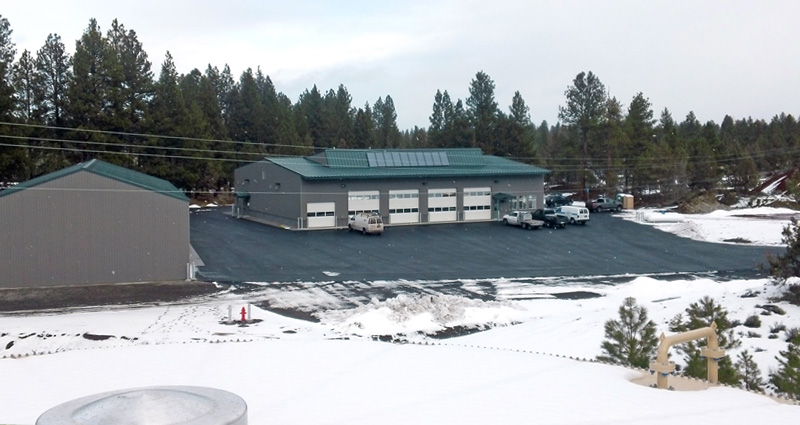
    ODOT Sisters Maintenance, Sisters, Oregon

    The Building: This project was a 10,000 square foot Maintenance and Office Building with 6,500 square feet of maintenance bays and support areas with heating and ventilation only. The remaining 3,500 square feet were office spaces with full HVAC.

    Connecting Solar and Geothermal: The primary source of heat was geothermal that included preheating by solar. This solar thermal system served a dual purpose, generating both heating water and potable domestic hot water for showers and office kitchen uses. Both heating water uses were supported by water to water geothermal heat pumps. All cooling for the offices was from the geothermal water to air loop. This combination of using solar for heating as the primary source with back up from geothermal combined two very efficient heating sources to create an efficient very low carbon footprint heating system. Each geothermal zone, office HVAC, heating water, domestic hot water, was provided its own geothermal ground tube system, allowing efficiencies in pump energy as a loop and only active when needed.

    Only Heat Where and When Needed: Heating of the service bays has two critical components. First was heating for worker comfort, second was heating to ensure that the sand in the sanding trucks did not freeze before it could be applied to roads. This was compounded by the fact that the large bay doors would be opening often and sometimes left open at which point no heating was desired for energy saving reasons. This unique set of needs led to a unique solution. Two separate heating systems were installed. For general space heating an underfloor radiant system was installed that was fed from the solar/geothermal source. This provided heating to the working on the floor where it is most needed. Each bay was designated as a zone with automatic shut off of the floor heating when the bay door is open. A propane fired infrared heating system was provided over the sand truck bays that is manually operated by the maintenance staff only when needed. This heat is directed only at the top of the truck where and when it is needed.

    The Long View: Considering the cost of these unique options and solutions to interesting design issues ODOT took the long view when considering the costs and benefits. This building was being designed as a 50 year building so first cost, while important, was not the only or even the primary factor in determining which choices to make. Paybacks within the 50 year life of the building were considered as worthy of consideration. If ODOT had been first cost driven they would have likely reduced installation cost significantly and perhaps saved some energy over the short term. But as system replacements become necessary and over the life of the building these costs would have been greater and greater. So in taking the long view ODOT saved money and energy while having a very small carbon footprint in the process.

    How this Applies to You: R&W understands that not everyone or every owner has the resources of ODOT to take a 50 year view of a building. But everyone does have the ability to look beyond first cost and consider unique solutions that might cost more initially but provide benefits in the future. Not all can or must be accepted but all can be considered and discussed. An open mind and a longer view than first cost, is all that is needed to explore options.

    Author: Edward A. Carlisle, P.E., LEED AP

    Mr. Carlisle, Vice President of R&W Engineering and in the industry for over 25 years, has a very extensive and diverse history in mechanical engineering and project management.  He is a LEED Accredited professional who has been involved in several LEED (USGBC) and SEED (ODOE) projects and has led R&W formal move into sustainable design.

  • A Lesson in CFD

    A Lesson in CFD

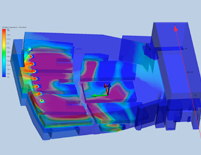
    There are certain moments in life when you see something and it just speaks to you. The first time I saw Computational Fluid Dynamics (CFD) in action, was one such time. I was watching a television show on Boeing Aircraft manufacturing. They were building a new jetliner and the documentary took the viewer behind the scenes to divulge how they come up with the design for a new jetliner. There was a segment on the shape of the wing. The goal was to reduce weight, increase lift, decrease drag; in turn these attributes would decrease fuel consumption, and increase efficiency. They used computers to simulate air moving over different shaped wings and could tell from these models which ones would be best suited for real world prototypes. Prototypes are extremely expensive to build.

    After the show had concluded, I would think from time to time how fascinating that technology was, more specifically their use of CFD. My career provided me the opportunity to learn the CFD Analysis and design program. I am intrigued that it can save energy therefore creating value, make less of a carbon footprint by using less material goods and thus making an environmental impact Being Green.

    CFD in its simplest form, is about describing the motion of a fluid, such as air, or water about an object. At its most complex, it can describe, in great detail, how fluid will transfer heat, transfer static electricity, change viscosity, produce sound, generate lift, how the water in your toilet will spin, how the water in the oceans will circulate, and even, how it will feel to be somewhere. It has been used for things as dynamic as solving aviation disasters, or space accidents. And as simple as, how your water mixes inside your faucet.

    Automakers often use CFD to design cars down to the minute details, such as shape of the wiper blades reducing the cross section of the vehicle. These aerodynamic attributes save us money. A simple test one can do, not while driving of course, is to put your hand out the window of a moving car. Position your palm so it is facing forward in the vehicle, and feel how much energy it takes to hold it in place. Now turn your palm face down, you will notice that it is a lot easier to hold your hand in place.

    CFD can be used to simulate stress of water over time on a bridge, or how air will interact with the bridge, think Tacoma Narrows Bridge. It can be used to make buildings safer, such as wind strength, or how quickly smoke will dissipate in a space enabling people to breathe.

    This technology has become essential in the design industry for designing ships, aircraft, automobiles, wind turbines, even spacecraft that interact with the atmosphere in any way. As often as CFD is used, there are even more applications where it could be used, but is not. Besides external design of a building, the inside of a building can be refined with CFD to provide maximum efficiency of the HVAC system, such as a Data Center. It can be used to view the air dynamics inside a sun-facing atrium in order to minimize energy usage to cool the space, or likewise heat a space, in Operating rooms controlling spread of contagions via air routing and ducting. Other applications such as hydro dynamics in a fishery, clean room particulate prediction and control, or building offices or buildings for allergen containment.

    The study and practice of CFD indirectly benefits us all on a daily basis. In the future, CFD will be used more widely in conjunction with like technologies such as simulation mechanical in designing parts for strength, while minimizing material needed and energy to build and therefore decreasing environmental impact. As the technology has evolved over the years the price has come down. With this combination, CFD is the next logical step in being healthier and green.

    Author: Justin Durow
    Mr. Durow has provided R&W with IT Specialist services relating to management of the following systems:  software, hardware, databases, Web resources, and network administration for over 8 years.  His knowledge in CFD Analysis has enabled R&W to expand with this service.
  • Low Hanging Fruit Energy Upgrades

    Low Hanging Fruit Energy Upgrades

    Would you rather walk 1 mile to get $100 or 100 miles to get $1? Except for an extreme walker, this question is a no-brainer. Just as water flows downhill and as nature abhors a vacuum, we all naturally take the option with the biggest reward and least amount of effort. This same analogy applies to a building owner or tenant who is interested in making upgrades and investments in their building to save energy. We all want the biggest bang for our buck. Since R&W’s founding, we have been helping building owners analyze building upgrades. In that time we have seen the following four consistently rise to the top.

    • Retro-commissioning: Just like us, building systems get old over time and stop working correctly. Retro-commissioning is like a complete physical for a building’s energy using systems to see what has failed or is limping along. It is amazing how often we find things such as exterior lighting on during the day, a broken damper linkage, a leaking coil or pipe in a basement, ventilation dampers held open with a 2×4, closet lighting on 24/7, a desk moved in front of a return air grille or programmable thermostats keeping full heating on at night. Often these problems can be corrected relatively inexpensively with huge energy savings.
    • Lighting: LED is steadily making advances. Many of our clients have been getting great payback by replacing inefficient high pressure sodium, incandescent or metal halide exterior lighting with LED lighting which uses a fraction of the energy. We are also seeing more customers replacing interior lighting with LED fixtures as the cost continues to drop. LED does not need replacement as often which saves on O&M costs. Low-wattage T5 or T8 fluorescent fixtures are great to replace old T12 or metal halide interior fixtures.
    • Control Upgrades: Many building owners are getting good payback from replacing their old leaky, pneumatic HVAC control systems with modern, digital, web-accessible controls. Energy saving features can easily be added such as installing CO2 sensors to turn down ventilation dampers, automatic indoor temperature adjustment based on outside temperature, intelligent morning warm-up that learns your patterns and occupancy sensors to activate things on only when people are present. A side benefit is that maintenance staff can be alerted to problems via their smart phones on a cold winter night and often address the situation without leaving home. Controls for building security, lighting and HVAC can all be integrated to work together. Increased range on wireless technology helps bring down the replacement costs as well.
    • Easy Building Shell Upgrades: No offense to the triple layer window salesmen going door to door but window replacement generally has a long payback time. Much more effective on one’s wallet is installing interior adjustable blinds and exterior shading devices that block the sun in summer but not in winter. Adding additional insulation to a poorly insulated attic space or a floor over an unconditioned crawlspace has a great return on investment, provided the existing structure doesn’t need to be opened up.

    The great news is with all the incentive money available from the state and utilities, now more than ever is a great time to make improvements to your building. The incentives available make the payback on qualifying energy upgrades even faster and encourage people to make these wise investments. Let us use our experience to help you save money, save energy and improve your building.

    Author: Mark D. Jones, LEED® AP
    Mr. Jones is very proficient at HVAC, piping and plumbing design, energy audits, life cycle cost analysis, LEED energy modeling and commissioning, as well as knowledgeable in the various mechanical, plumbing and energy codes.  He has worked on various projects with utilities and state agencies, including Energy Trust of Oregon, Clark Public Utilities, Bonneville Power Administration and Oregon Department of Energy to improve energy efficiency for clients while helping in securing rebates and incentives. He has taken the lead in developing and promoting R&W’s energy efficiency and commissioning services.
  • Casual for a Cause Fridays Hits a Milestone

    Casual for a Cause Fridays Hits a Milestone

    Eleven years ago, R&W Engineering began a tradition that would impact many lives for years to come. Casual Friday for a Cause not only allotted for the employees to dress in their favorite comfortable pair of jeans on fabulous Friday, but also asked that each employee donate five dollars to the selected charity of the quarter. The employees agreed together this could be an opportunity to give back and make a difference. Each quarter R&W employees vote on a charity and all the money raised during that quarter is donated to that charity. R&W employees fund local charities as well as nationwide organizations. Over the last 11 years, R&W employees have donated over $30,000 to different charities and organizations. Some of the different charities R&W has been a part of are the American Heart Association, Royal Family Kids camp, Oregon Food Bank, Mercy Corps, Dove Lewis Animal Hospital, Sports Outreach and many more. Casual Friday for a Cause is a wonderful opportunity to involve ourselves with our community beyond our office walls.

    Some of our most memorable contributions have gone to Cassie’s Angels and the J.P. Carlisle Foundation. Cassie’s Angels is a foundation organized to financially and emotionally support a seven year old girl battling a rare cancer call neuroblastoma. Our donations went to the research as well as medical expenses for this family. The J.P. Carlisle Foundation was a charity set up for a US Marine who suffered a traumatic brain clot while on assignment. The funds raised at R&W helped to cover medical expenses for J.P. and his family.

    Other organizations are the Oregon World War II Memorial and Home Plate Youth Services. The WWII memorial pays a deep respect and appreciation to the thousands of Oregonians who gave their life during this war and our support in this charity has helped with maintenance of the memorial. Home Plate Youth Services charity assists children up to the age of 24 who are homeless or in unstable living conditions. This organization provides meals, resources, access to education, and so much more to thousands of children in need.

    As a donating employee, I must say the dollar amount is quite impressive. It is hard to imagine just $5 a week was able to contribute to all of that. However, beyond the numbers of money donated are the smiling faces and happy hearts of those whose lives were impacted by a simple five dollar bill. I am happy to say that I am a part of an organization who values the lives of others, and those in need within our community.

    Author: Jennifer Martinez, Administrative Assistant for R&W Engineering
  • The Enginerd

    The Enginerd

    The Enginerd. He is the unfortunate result of unofficially adventurous tedium’s of engineering combined with the additionally tiresome cross-referencing of restrictions placed by countless numbers of officials and experts tying hands at every turn to collate into a vortex of nerdism equating to high level thought processes combined with exceedingly dull, monotonous, diminutive, inter-personal skills and outrageous conceptualizations. His mission is to solve the physical problems of societal infrastructure to not only maintain, but improve the quality of life for both the private and public sectors. It’s just that simple…or is it?

    We join one such Enginerd tasked with reconfiguring a new private sector system to comply with the public sector rules, regulations and guidelines for sustainable green power generation in a local area. This unprecedented project yields the ability to utilize energy from the local infrastructure instead of just discarding the energy it stores as a byproduct through conventional means in order to reduce excesses that would create problems for the end users. And though some scorn the thought of attempting such ventures citing the laws of physics as not allowing the project to be fruitful, those involved understand the entire system and why such a project could revolutionize sustainable power with low environmental impact for many areas of the modern world.

    Though the concept is relatively simplistic, the application of such a venture is anything but simple. Sophisticated and specialized equipment is necessary to perform this power generation. The Enginerd must review the necessary processing equipment to be used then determine the additional components required so that it is not only functional but tolerable to local, state and national jurisdictions. Add to the complications, the virtually non-existent available real-estate in the only location permissible for installation of the project, and the Enginerd has been placed face to face against an unwavering bureaucracy of foes.

    A technical solution to compact and minimize impact is not enough for this project. The Enginerd must argue the interpretation of laws, codes and regulations with the same entities wanting the project to succeed because of aesthetics! How will this ever result in a successful project? Fear not, a solution is at hand.

    Upon hours of reflection and turmoil in devising a course of action to appease the lords and ladies of public office presiding over final acceptance adherent to their criteria, an acceptable solution emerges from the shadows of the mind. Eureka! With the majority of the equipment located underground, the remaining equipment can be hidden from direct site through the use of expensively extravagant art.

    The plan is set in motion. All parties involved agree satisfaction has been achieved. The project is a success! “We have done it!” the Enginerd exclaims. But within seconds of this outcry of relief, an email appears in the Enginerd’s inbox with the subject line: Electrical Inspector Comments. Upon examination of the email the Enginerd drops his head in reflectance of defeat, then slowly raises it all the way back as he inhales deeply, then screams, “Curse you NEC!!!”

    Author: Sam Russum, P.E., LEED AP
    Mr. Russum is an Electrical Engineer and has been in the engineering field since 2006.  He has practical experience in lighting, power and control design for various industrial, municipal and commercial projects.  His experience includes power distribution, lighting, emergency power, SCADA, and telemetry systems as well as PLC and HMI programming. 
  • Humans ≠ Numbers

    Humans ≠ Numbers

    Imagine a workspace of twelve-by-twelve cubicle after twelve-by-twelve cubicle filling the entire floor space. Common thought would consider this a boring place, not because of its lack of interesting features, but because of its sameness. Its sameness with all other offices in the world. The current method of herding and stabling the worker: accepted by all; liked by few. The lunchroom is a small, brief respite in the vanilla plain world, where the difference allows an openness otherwise neither considered nor accepted. “Can you believe that John is a department manager?” Asks one. “Yeah, if people were numbers on a spreadsheet or in an equation he might actually be good at it.” Another replies.

    This is John’s domain; here he is king. A place where the laws of physics are supreme, where Bernoulli, Watt, Mohr, and others defined reality hundreds of years ago. He had proven himself an excellent engineer and been rewarded with his own serfdom. He would conquer this like he had engineering, merely by applying the rules and obtaining the desired outcome. This was not a difficult assignment, others had succeeded, and those who failed had clearly not properly applied the laws. As for workers who do not fit in, they are merely rounding errors. Ignore them, give them the undesirable project and soon enough they will leave.

    In spite of the externalities most people are content, if not happy here. The engineering is interesting; the co-workers enjoyable. In general this place is as good as any to spend the required time among the employed. That is if you are not considered a rounding error. For those who choose to rebel against the sameness of this kingdom life is quite miserable. Yet the true problem lies not in those who rebel continuously but in the fact that human thoughts and behavior do not always obey the laws of physics that John would have rule this place. So everyone at one time or another (because independent thought and emotions cannot be quelled) at least visits the realm of the rebel.

    When people cannot control that which makes them more than calculable figures, a confrontation with John will occur. Since no one has complete control of their humanness, emotions or thoughts, confrontation with John is inevitable. People either conform or leave; things continue to be the same. John, through lack of any introspection or lasting opposition, gains more power which reinforces his belief that people are numbers and he is as good at managing people as he is at engineering. The average worker remains relatively happy in spite of him.

    This all too familiar narrative describes most engineer/managers to some extent. We must remember that people do not, in fact cannot, fit into equations. Just because ‘C’ looks like ‘A’ and ‘B’, they are not necessarily all the same. To use a concept that is criticized as fad by some and completely adopted by many in the management and leadership community the engineer/manager must know and improve their Emotional Intelligence. A good place to start would be using this psychtest evaluation tool. It will likely be eye opening and provide some feedback to fuel positive introspection on how you relate to employees, co-workers, clients, vendors, sub-consultants, and even family.

    About the author: Ed Carlisle is a Vice President and Senior Mechanical Engineer at R&W, he is a Registered Professional Engineer in 5 states. He holds a Bachelor of Science Degree in Management and is currently studying for a Master of Arts degree in Strategic Leadership.