

Grace provides design services for HVAC, plumbing and piping systems for commercial and industrial projects. Grace has a bachelor’s degree in mechanical engineering from Oregon State University.
Author: Jessica Riedl
-

R&W Engineering has hired Madison Chenault as Project Coordinator.
Madison is responsible for supporting the project managers for administrative operations on various project tasks. Madison holds a bachelor’s degree in journalism and communications from University of Oregon.
-

R&W Engineering has hired Mel Parker as an electrical engineering designer.
Mel provides design services for electrical systems for commercial and industrial sites. Mel has a successful background as a journeyman electrician and a Bachelor of Science degree in Electrical Engineering from Oregon Institute of Technology.
-
R&W Engineering has hired Megan Richmond
R&W Engineering has hired Megan Richmond as Office Coordinator. She contributes to front-office administrative operations and supports the firm’s team on office and project-specific tasks.
-

R&W Engineering Hires Ramona Graves
Ramona has over 20 years of finance experience with accounts payable, accounts receivable, bookkeeping, and payroll.
-

Balancing Work & Family – Can it be done?
Author: Heidi Speer
The task of balancing your work-life with your personal-life can be daunting, and in some cases, it can result in one of those two sides, losing. So which do you sacrifice: Work or Family?
For me neither was an option. Which was why “who” I worked for was so important when it came time to commit to a permanent position.
I had spent three years in that precarious position of contract employee, where your income was only guaranteed for a short amount of time. As a single parent that caused more than a few sleepless nights. I was eager for the stability that a permanent position offered, but I was worried what a permanent position might cost me when it came to my young child.
It was always the most heart pounding moment of a job interview. Bringing up the fact that I was a single parent to a 5-year-old and asking how a potential employer felt about the inevitable sick child phone call I’d get from the school that would cause me to leave work suddenly. There was the chance that your employer would appear to be sympathetic and understanding of your situation during the interview, however, in reality, if your child called you away from work more than two times it would actively start to affect how your employer treated you.
When R&W informed me that they were a “family first” company, I was relieved but knew to take all comments with a grain of salt, realizing that each company had their own definition of the phrase.
I’m happy to say that almost 12 years later, R&W is still true to their word. Whether you, a child or a pet is fighting an illness. If you must leave early for soccer practice, a school production or an anniversary dinner; management and co-workers are understanding. Flexible hours are available to help make-up missed time, and remotely accessing your work computer from home to keep on top of projects, helps relieve any stress someone may have for being away from their work obligations. It creates a balance that can be hard to achieve.
Finding a company that understands and accepts that an employee has responsibilities that lay outside the office, is important. Being a part of a company that believes that, and proves their belief every day creates a loyal work force that will give 110%, knowing that their company will support them in return.
-

Exploring Oregon
Author: Tonya Minnick
Growing up in Nampa, Idaho near Boise (boy-see to the natives), and being a young single parent, I never got the opportunity to explore outside my boundaries. (Un)fortunately for me, the company I had been working at for the last couple years, decided to downsize starting with the newest employees in my department. No notice, just took my key card and booted me. Coworkers were nearly in tears as they lost two people that day and we were already working fifty hours a week. So, I saturated the market with my resume.
My interviews went great but Idaho isn’t known for fair wages. I continued to get interest at wages lower than what my unemployment checks were already supplying. Then the out of state calls started coming. North Dakota had a great offer, but I wasn’t interested in living there. Seattle would be a nice place to live but who can survive in Seattle on the, twenty dollars per hour, offer I received? This continued to discourage me. Then I got a call from Volt Workforce saying they had an opportunity in Beaverton. “Where is Beaverton?” I asked. “The home of Nike.” *silence* “Near Portland Oregon.” “Oh” I replied. “Sure, I’ll come out for an interview.” Two days later I was in my car headed to a town full of Beavers. Ten days after that, I was in that same little Saturn loaded to the brim with as much as I could pack into it. This included an air mattress, a relentlessly howling cat, and a little dog that insisted on riding atop the immense pile of precious necessities.
When I got here I had very little and was extremely nervous, as this was my first big adventure. Luckily the apartment I managed to get at the last minute, worked out wonderfully and was near work. Right away I noticed people were willing to help with my situation. I was given furniture, dishes, advice, etc. These items came from, co-workers, new friends, one old friend that happened to be in the area, and a plethora of strangers. In what seemed like a very short time and only about five hundred dollars later, I had my apartment in a livable condition. I even had a real bed. And I was starting to make more friends that I could explore Oregon with.
Since getting settled in, I have taken many a trip to the coast and watched the gray whales and was able to witness some pretty spectacular breaches. While I had seen the Oregon Coast before, I never had the time to just relax and take it all in. Nor had I ever seen a whale in its natural habitat. Now I can go every weekend if I feel the need, and spend hours just looking out into the vast horizon. I finally experienced one of the most exhilarating moments of my life when I saw the tails of two Orca swimming toward the deep from Cannon Beach. Did I mention that as a teen I had planned to attend OSU to become a marine biologist and study the Orca? Unfortunately, only the Jacque Cousteau’s of the world make a living sailing the seas and widening minds. But to see the multitudes of gray whales and then my Orca sighting, I was finally home.
While the sea side is my favorite Oregon location, I have found several other exciting places. The Tualatin Hills Nature Park is one of my favorite locations. It is chalk full of little critters and it’s a beautiful place to get your daily 10,000 steps in. Apparently, there are deer hiding in there too, but I have yet to find them. I personally have found, owls, bunnies, squirrels, toads, lizards, slugs, and a plethora of birds. It’s only one of many available trials in the area. Including the lovely Fanno Creek Trail. I have seen several great blue herons in the creek. Multnomah falls is also amazing. I have been up on the bridge but have not explored the higher trails. It’s a gorgeous natural waterfall with a manmade bridge to get us closer to nature. Oxbow park is also a wonderful place to visit. I love the river, as it reminds me of the parts of Idaho I tend to miss on occasion. The self-titled little town at the base of Mount Hood also reminds me of the little Idaho town, of Marsing. The orchards and vineyards here are breathtaking in the fall. The little lodge at the base of the mountain was quaint but the road to the peak was closed due to snow, when I went. I can’t wait for next summer to explore some more.
The food scene is also spectacular here. I have discovered several scrumptious locations for tasty goodies. I know Voodoo Donuts is a landmark but I’m in love with Beaverton Bakery. I also found Mizumi Buffet, some delectable Chinese style seafood in a nice sized buffet. Then all the noodle options to choose from at various places. I also love Mod Pizza, as they are like the super subway style pizza palace, with marion-blackberry lemonade that is amazing. Portland Saturday Market with all the lovely food cart options, food pods as far as the eye can see, in downtown Portland and strewn about all the outlaying cities. My favorite Mexican food is in Vancouver (I know, not in Oregon), Taqueria El Antojo. They have the best tortilla soup and Mexican juices ever! This is accounting for the fact that Nampa has a heavy Hispanic population. There are also plenty of health conscious, yet delicious marvels to be found. Sweet Tomatoes is a nice healthy buffet. Just don’t overload on salad and soup. I am still hunting for my favorite places. It could take me years to find the best of the best. I am however, up for the challenge.
I am sure there are a multitude of Oregonian things I haven’t tried. I know there are several things on my list to explore. I am always eager for suggestions. It would be awesome if some of you would leave some of your favorite places in the comments below. Hint, hint. Maybe you’ll feel the need to try a new place that I happened to find and mention here. I just want to say, I am so thankful to have found a company to work for, where my coworkers are also my friends. It was a leap of faith that brought me here and I am so glad I took that leap. I have found people I can count on if need be, in this new little family. This new adventure has definitely been a positive move. Of course, I miss aspects of Idaho, with friends and family at the top of the list. But, I feel like I belong here. I would like to thank each of you all for that.
Author: Tonya Minnick
-

Fire Flow Tests, How & Why
Fire Flow Tests, also known as Hydrant Flow Tests can be performed for several different reasons.
Why
In general, fire flow tests are conducted on fire hydrants to determine the water availability.
There are multiple reasons why a flow test could need to be performed, below is a list of several of these reasons:
- To determine water availability in planning for firefighting activities.
- To determine water availability for the design of fire sprinkler systems.
- To determine water availability for the design of domestic water systems.
- To evaluate development of water main extensions.
- To evaluate system improvements and replacements.
- To determine the general condition of the water distribution system by detecting closed valves.
Fire flow testing produces accurate water data which can be used for various purposes. Fire Fighting Agencies use this water data for training, planning and marking hydrants. This water data is also used for water system planning and design. Municipalities also use the water data to simulate high flow conditions, to determine pressure and flow-producing capabilities of the water distribution system and for calibration of hydraulic models.
How
How often do Fire Flow Tests need to be performed on hydrants?
- AWWA recommends flow testing all areas at least every 10 years (AWWA M17, chapter 6).
- NFPA requires flow testing of underground and exposed piping at least once every 5 years (NFPA 25, Table 7.1.1.2, 2014).
How are Fire Flow Tests performed?
There are two types of Fire Flow Tests:
- Main Capacity Test determines the water supply availability in the water main. If you are designing a fire sprinkler system, use this test (residual hydrant + separate downstream flow hydrant).
- Hydrant Capacity Test determines the flow-rate available from the hydrant and if it will deliver in a fire emergency situation. If you are performing fire flow tests of hydrants, use this test (residual hydrant and flow hydrant are the same one).
For the purpose of this Blog we will only discuss how to perform a Main Capacity Flow Test, which is the two hydrant flow test. A Main Capacity Test evaluates the water supply of the fire main at the location of the test hydrant. The information derived from this test is used by city planners and contractors to consider the water supply for general use and fire sprinkler systems.
Setup:
At the test hydrant (pressure hydrant, static/residual hydrant):
- Attach gauge cap to test hydrant. Tighten all other caps.
- Open test hydrant, vent air from hydrant body through the valve on the gauge cap assembly. Close it when air is vented.
At the flow hydrant
- Set the Little Hose Monster™ with gauge to the Pitotless Nozzle™ in an appropriate location for flowing water.
- Attach Remote Reader and gauge to the Pitotless Nozzle.
- Attach hydrant gate valve to the hydrant and close the gate valve.
- Tighten other caps.
- Attach the hose to the Pitotless Nozzle and Little Hose Monster assembly.
Conduct the test
- Record static pressure reading from gauge cap.
- Slowly open hydrant using the gate valve to purge air from the hydrant. When hydrant is full of water, open gate valve to desired flow-rate (usually full open).
- When the flow-rate stabilizes,
- Record nozzle pressure from the remote reader.
and at the same moment
At the test hydrant
- Record the residual pressure reading from the gauge cap.
At this point, the test is complete.
- Slowly close gate valve on flow hydrant, then close the hydrant. Remove test equipment from hydrant. Replace and tighten cap. If the hydrant is a dry barrel type, note that water drains properly from the hydrant.
- Record the number of minutes that water was flowing. This can be used to account for the amount of water used during the flow test.
At the test hydrant
- Close the hydrant. Remove gauge cap and replace hydrant cap. If the hydrant is a dry barrel type, note that water drains properly from the hydrant.
The information collected from this test can be used to predict flow-rates and residual pressures.
Now you know the How & Why of Fire Flow Tests a valuable tool in the engineer’s arsenal.
About the Author: Dwayne Johnson
Mr. Johnson brings over 25 years of experience in the industry and a majority of his experience is with design build contractors preparing detailed installation drawings and calculations. His expertise is in fire protection, plumbing and all aspects of mechanical systems design.
-

Is your home lighting causing you unnecessary stress?
Lamp Colors for the Home
With the changes in lighting technology the color of the lamp within a lighting fixture has become much more important. The color of the lamp can actually affect your body, mood and the perception of a room.
It is often difficult for the average person to know what is happening in the world of lighting technology and the advancements that have been made to improve their environment. With so many other questions and concerns occupying their daily thoughts and time, not much effort is put into considering different lighting strategies that can better their environment. What many consumers fail to understand is that inadequate lamp quality can cause unnecessary stress. There are several spectrums that can be identified on the lamp packaging to aid in your search for which lamp best suit your needs.
What is Color Temperature?
Color temperature is conventionally stated in the unit of absolute temperature, in Kelvin, having the unit symbol K. The color temperature of a light source is the temperature of an ideal black-body radiator that radiates light of a comparable hue to that of a light source. Black-body radiator test creates the base color for color temperature light that will be omitted from a lamp source. The color temperature depicted on a line ranges from reddish/orange to yellow, and to more or less, white to blueish white.
Color Temperature
Within the home, the lamps you will find most often are generally incandescent bulbs, compact fluorescents, MR16’s, halogen and LED lamps. As well as within the home, you may also have lamps on the exterior of the house in the form of metal halide, high pressure sodium or mercury vapor.
Most commonly found are lamps with color temperatures of 2700K, 3000K, 3500K, 4100K and 5000K. It isn’t as common, but you may find other color temperatures depending on the lamp manufacturer.
The lowest color temperature is 2700K and its lamp appears reddish and is a warm color. Incandescent lamps are 2700K and are the best light temperature to be around while relaxing and prior to going to bed because of the warm soft hue.
The color temperature of 3000K to 3500K are a comfortable light range for indoor activities. The light appears to be a whiter light and colors are more vivid. These characteristics, in my opinion, are what makes them the most common color temperature for commercial businesses.
A 4100K lamp temperature appears much bluer compared to the 3500K lamp temperature. This light is most often used in hospitals and office buildings. This light temperature is better for performing fine motor tasks, reading and general desk work.
Much like the previous, a color temperature of 5000K appears bluer than the 4100K. Although quite high on the color temperature scale, this is not the highest color temperature. There are higher temperature lamps for uses such as industrial work, aquarium lighting and agricultural grow lights.
What is the Color Rendering Index?
The Color Rendering Index (CRI) is the measure of the ability of a specific light source to reveal the colors of objects in comparison with the ideal or natural light source. This index has a scale ranging from 0 to 100, with 100 being the closest to a natural light source. A light source that is generally 80 CRI or above is most commonly recommended for the best lighting results.
What is Lumen Output?
In simple terms, the lumen output is the amount of light omitted from a light source prior to being installed in a light fixture. Most lamp packaging will come equipped with information comparing incandescent lamps against other types of lamp sources. Most are familiar with incandescent lamps and the amount of light perceived to be omitted, which aids in identifying how the bulbs will differ from one another depending on the lumen output.
Hopefully the above aids you in finding the correct lamp, or other light source for your lighting application at home. It may help to take a similar or burnt out lamp along with you on your search to be able to compare lamps for your application. Often times this aids in knowing what wattage, lamp style or socket is appropriate.
Now go get creative with your at home lighting.
Author: Dennis Hall
Mr. Hall has been an electrical designer for over 25 years, specializing in energy efficiency lighting design for commercial buildings.
-
Variable Refrigerant Flow (VRF) Systems
VARIABLE REFRIGERANT FLOW SYSTEMS
Summary
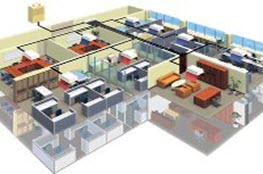
A Variable Refrigerant Flow (VRF) heating and air conditioning system is a specific type of HVAC system which utilizes one outdoor unit that connects to multiple indoor units. These indoor units can be single systems; serving one space, or a ducted system; serving multiple spaces. The indoor units are controlled individually by a room thermostat in a variable flow mode, while the outdoor unit provides the refrigerant. This provides for the heating and/or cooling of the individual interior space. The outdoor units can be either air cooled or water cooled and the indoor units are connected to the outdoor unit via refrigerant piping.
History
VRF systems have been in existence for approximately 30 years. The VRF system is a variation on the individual mini ductless split systems which were commonly used to condition small data rooms or individual rooms where a heat producing load was located, or in a space where a larger system was not required.
These systems have become very popular across the globe, particularly in places such as Europe and Japan. These areas tend to have high electricity costs. By utilizing the high efficiency of the VRF systems the cost of operation can be reduced.
In the Pacific NW, the manufacturing of VRF systems was previously dominated by three (3) main companies. However, as the popularity of this type of system has increased, the number of manufacturers entering the field has tripled, growing from three main dominating companies to somewhere from 8 to 10 that we know of. The individual room control as well as the type and size of a building now utilizing VRF technology has heightened the expansion of these systems. They have now made their way into the construction industry because of their high efficiency.
What is a Variable Refrigerant Flow System?
A VRF system is an air conditioning/heating system where multiple indoor units can be connected, via refrigerant piping, to a single outdoor unit. There are two types of systems: Heat Pump and Heat Pump with Heat Recovery. The heat pump system operates similarly to a standard heat pump where the outdoor unit is either in the heating or cooling mode and all indoor units are operating in the same (heating or cooling) mode. The heat recovery heat pump system allows the individual space connected indoor units to be in either the heating or cooling mode whilst not requiring the outdoor unit selecting the mode. This, is accomplished by piping refrigerant from the outdoor unit to a distribution box (circuit controller, branch selection box, etc.) and then routed using a second set of refrigerant pipes to each individual indoor unit. This allows diversification in the overall cooling and/or heating load and greatly increases energy efficiency.
Indoor units range in size from less than 1 ton up to approximately 8 tons. These units can be a fan coil type; either ducted or non-ducted, an exposed ceiling mounted unit, a concealed ceiling mounted unit or a wall mounted unit. Outdoor units range in size from approximately 5 tons for a single unit, up to 30 tons for multiple units connected together to form one single larger tonnage unit. Example: (2) 5 ton units can be connected to form a single 10 ton unit or an 8 ton unit can be connected to a 10 ton unit to yield a total tonnage of 18 tons and an 8 ton unit can be combined with a 10 ton unit and another 10 ton unit to yield a total tonnage of 28 tons. While being configured from multiple units and requiring separate power connections, the resulting “combined” unit is considered a single unit.
While a conventional HVAC system has outside ventilation air as part of the packaged system, VRF systems, although generally having outside air capability, usually require a dedicated outdoor air system (DOAS) to operate in conjunction with the VRF to provide ventilation air to the occupied spaces where the VRF provides the heating and cooling and the DOAS provides for the ventilation. The DOAS only provides for the ventilation required by code thus the air side capacity of the system is not as great as a conventional all-air system which is providing ventilation air as well as enough air to be heated and cooled to satisfy the temperature control of the space. Most VRF manufacturers do offer DOAS equipment which integrates into the control system for the VRF.
Temperature control and system control of a VRF system is provided by the manufacturer of the system. Manufacturers have their own proprietary control systems. A component of one manufacturer cannot be used in another manufacturer’s system.
Design and Installation
The design of the VRF system should be done by an individual who is knowledgeable in VRF systems and who has been trained by the manufacturer in the design of their particular product. The recommendations of the manufacturer should be followed completely in the design process. It is important to “zone” the systems properly and to always keep the length of refrigerant piping as short as possible. The use of isolation valves, both in “zones” and on individual pieces of equipment is recommended for both an ease of installation and testing basis as well as for ease of maintenance after construction.
Since there is considerably more refrigerant piping being installed in a VRF system than a more conventional system, the quality of the installation becomes paramount. Piping needs to be cleaned and capped. Air inside the piping needs to be purged and nitrogen used during the brazing of the pipe.
Pressure testing of the piping should be accomplished in accordance with the manufacturer’s recommendations.
The installation should be provided by a contractor who has completed the installation training classes provided by the manufacturer and the designer should include in the installation specifications that the manufacturer or the manufacturer’s representative should inspect the installation.
Pro and Cons of VRF Systems
Pros
- Heat Recovery systems can be very energy efficient.
- VRF systems (per current code) can be exempt from the economizer code requirements.
- Minimal ceiling space or minimal space inside the building is required.
- Very effective in remodel projects.
Cons
- This option can be costly.
- VRF systems are single manufacturer driven. If a system is provided by manufacturer A, components from manufacturer B cannot be utilized in the repair/modification of the system.
- Refrigerant capacity. The total capacity of refrigerant in the overall system is greater than the amount allowed by code for indoor air quality.
Authors: Don Pfaff, P.E. and Kristin Trone
Mr. Pfaff, during his 40 years of experience, has been a designer, a Professional Engineer, a Senior Mechanical Engineer and Project Manager. At R&W Mr. Pfaff acts as a mentor to other designers and engineers as he is very knowledgeable in the design and installation of various mechanical systems including HVAC, Plumbing, Controls, Piping and Fire Protection.
Ms. Trone has over 28 years in the engineering field with 20 years as a HVAC designer. Ms. Trone is very familiar with the energy code issues of various states and is also very proficient at calculating building HVAC cooling and heating load and has designed tenant improvement systems for commercial office buildings that include single and double duct VAV, reheat VAV, constant volume, hydronic heat pumps, air cooled split systems and computer room cooling systems. She has designed projects and managed construction for both new and remodeled buildings.